
The cheapest revenue you have is the list you already paid for.
Every euro of media leaves something behind: an address, a browse, an abandoned basket. Flows and campaigns are how that becomes a second and a third order without buying the same customer twice. It’s the one channel where the audience is already yours.
- Free audit within 2 days
- No account access needed
- You own every account
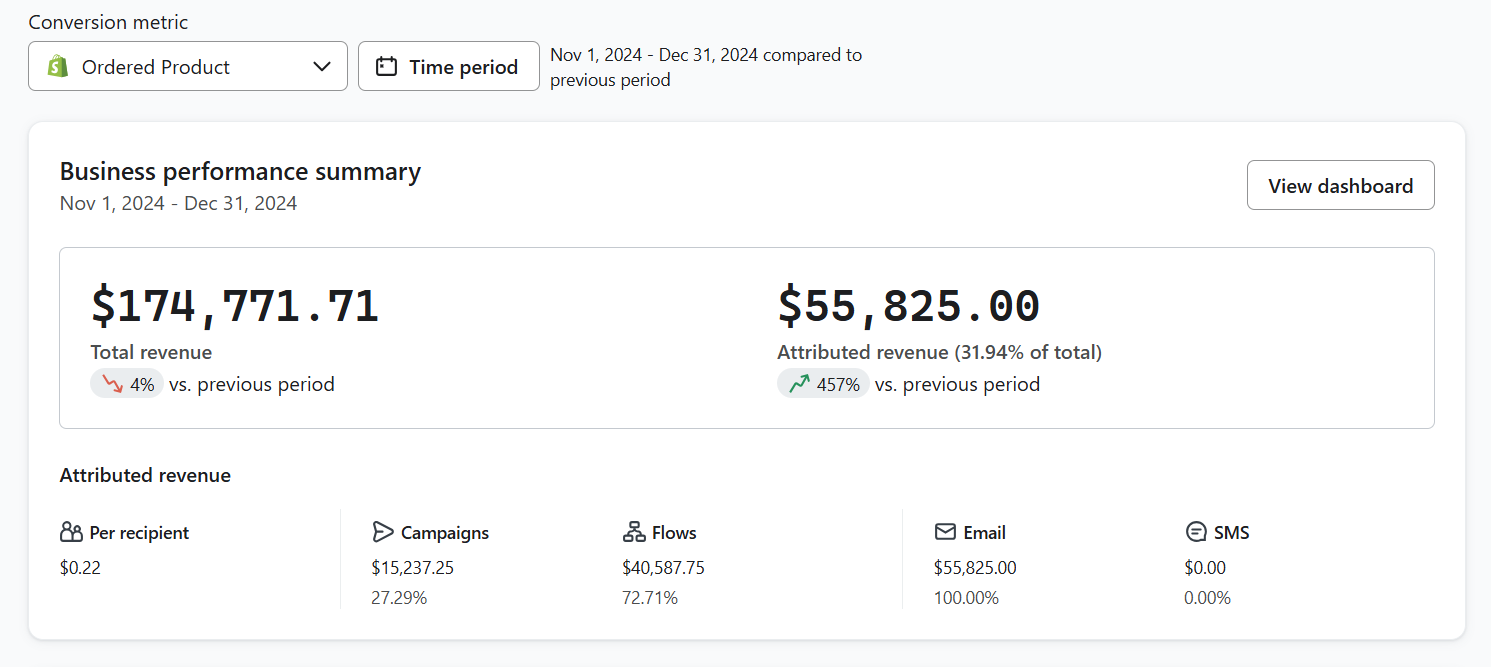
- Flows72.71%
- Campaigns27.29%
- Welcome
- Browse abandon
- Cart
- Checkout
- Post purchase
- Winback
- Back in stock
We wrote the flows on our own brand, then sold the brand.
Curated Chrome was ours. Across November and December 2024 the store took $174 771.71, email was credited with $55 825.00 of it, and 72.7 percent of that came from always on flows rather than campaigns sent by hand. Revenue on the days nobody pressed send. The case study opens the Klaviyo dashboards behind it. Why we measure it against the store is in a separate note.
- Welcome
- Browse abandon
- Cart
- Checkout
- Post purchase
- Winback
- Back in stock
Every chip is work we do.
Four things happen every month, whatever else does.
Flows don’t stay tuned, lists don’t stay clean and inboxes don’t stay open. The work is what keeps all three from drifting while you’re looking at something else.
Flows7
- Welcome
- Browse abandon
- Cart
- Checkout
- Post purchase
- Winback
- Back in stock
Campaigns5
- Calendar
- Segments
- Subject line splits
- Offer tests
- Template system
List4
- Capture points
- Sunset policy
- Suppression hygiene
- Growth sources
Deliverability4
- Domain authentication
- Warm up
- Inbox placement
- Engagement tiers
The order we work in, from the week you say go.
- 01Week 1
We audit the account and the inbox
Every flow, every segment, list health, sending domain and deliverability.
- 02Week 2
The revenue flows go in first
Welcome, browse abandon, cart, checkout, post purchase, winback and back in stock.
- 03Week 3
Segments, then a calendar
The list split into groups worth talking to separately, and a campaign calendar booked against the trading year rather than against whoever happened to remember.
- Every week after
Send, split, read, repeat
Campaigns out, subject lines and offers split tested, flows tuned on what came back.
What actually moves the account.
Flows before campaigns, always
A campaign sells once. A flow sells while you’re asleep, every day, forever. We build the seven that carry the revenue first and only then argue about the newsletter.
Segments that mean something
First time buyer, repeat buyer, lapsed, high value, browsed and didn’t buy. Sending everyone the same thing is what taught your list to stop opening.
Deliverability treated as infrastructure
Authentication, sending domain, warm up, sunset policy and engagement tiers. Inbox placement is the ceiling on every other decision in the account, so it gets set first.
Written like the brand, not like the tool
Klaviyo ships good defaults and every store using them looks the same. Yours gets a template system built from your own site, so the email and the shop are one thing.
Timing set by behaviour, not by a calendar
Delays, splits and conditions that read what somebody actually did. A cart reminder that lands ninety minutes later does work that the same email can’t do the next morning.
Measured against the store, not the platform
Klaviyo will happily claim an order the ads paid for. We set attributed revenue next to total store revenue, so the number in the report is one you can defend to anybody.
What you get every month.
Every flow built and live
Not a plan for flows. Built in your account, styled to your brand, switched on.
A campaign calendar you can see
Booked ahead against the trading year, so nothing goes out because it was Tuesday.
Deliverability held on purpose
Authentication, warm up, sunset and engagement tiers, checked rather than assumed.
The account stays yours
Klaviyo, the lists, the templates and the flows, in your name from the first day.
Nothing on this list is yours to chase.
- Us 7
- Together 1
- You 1
- Campaigns sentTwo to four a week, by planUs
- Flow performance review and tuningEvery monthUs
- Subject line and offer split testsEvery campaignUs
- Segment and list health passEvery monthUs
- Deliverability and inbox placement checkEvery monthUs
- Email revenue read against store revenueEvery weekUs
- Written reportEvery MondayUs
- CallEvery weekBoth
- Approving an offer or a promotionWhen there is oneYou
Two ways to pay for the flows and the calendar.
A fixed monthly fee, or a commission on the growth instead of most of that fee. Email is the cheapest channel you own, so the number is small either way, and it’s agreed before anything is built.
A fixed monthly fee
One amount, agreed before anything starts and unchanged when a month turns out heavier than the last one.
- Set by what the business needs, never by the hour
- No percentage of your media budget on top
- Reviewed once a quarter, never mid-month
A commission on the growth
Most of the fixed fee comes off and we take a share of what the work adds, measured against the same month a year earlier.
- Read from your own numbers, not from what a platform claims
- Capped, so a very good month never becomes a penalty
- You keep the accounts either way, permanently
There is no rate card. Which structure fits, and what the number inside it is, depend on what the business actually needs: margin, seasonality and how much growth is already in motion. We’ll tell you which one we’d recommend and why, in the same document as the number.
See what it would costChannels aren’t run in isolation.
What we learn in one shows up in the others, which is why we run them from the same desk rather than treating each channel as a separate account.
- Meta advertisingStructure, creative and measurement that survive contact with reality.
- Google advertisingSearch, Shopping and Performance Max, starting with the feed and the products that actually matter.
- SEO and GEOPages built for the searches people make, and the AI engines increasingly shaping how they discover brands.
- CRO and websiteThe store itself: built, tested and optimised to convert more of the traffic you’re already paying for.
- Creative directionHooks, angles and the brief your team produces from, judged against what performs.
The questions that come up first.
Flows or campaigns first?
Flows, always. A campaign sells once and a flow sells while you are asleep. We build the seven that carry the revenue first and only then argue about the newsletter. On our own brand, across November and December 2024, 72.7 percent of email revenue came from always on flows rather than campaigns sent by hand.
Which flows actually carry the revenue?
Welcome, browse abandon, cart, checkout, post purchase, winback and back in stock. Those seven get built and then held, with a performance review and a tuning pass every month.
How many campaigns go out, and who writes them?
Two to four a week, on a calendar rather than when there is time, and we write them. Every campaign carries a subject line or offer split, so the calendar keeps teaching the account something.
Open rates fell off a cliff. Is that the writing or the inbox?
It is the first question we answer, before rewriting anything. Deliverability is treated as infrastructure: authentication, sending domain, warm up, sunset policy and engagement tiers, checked every month against real inbox placement.
How is the email work priced?
A fixed monthly fee, or a commission on the growth instead of most of that fee. Email is the cheapest channel you own, so the number is small either way, and it is agreed before anything is built.
What if our list is small?
Then flows matter more, not less. Every euro of media leaves an address, a browse or an abandoned basket behind, and flows are how that becomes a second and a third order without buying the same customer twice.
Let’s see what’s holding your growth back.
Send the brand, the channels and roughly what you spend. Your written audit follows within two days.
Or write to hello@roasdept.com
Pick what matters and the audit is written around it.