
Be the answer, whether it is a blue link or a generated one.
Search is splitting in two. Some of it still ends in a click and a growing share ends in an answer written by Google, ChatGPT or Copilot. We build for both at once, because the same work feeds them: pages that answer real questions, structured so a machine can quote them.
- Free audit within 2 days
- No account access needed
- You own every account
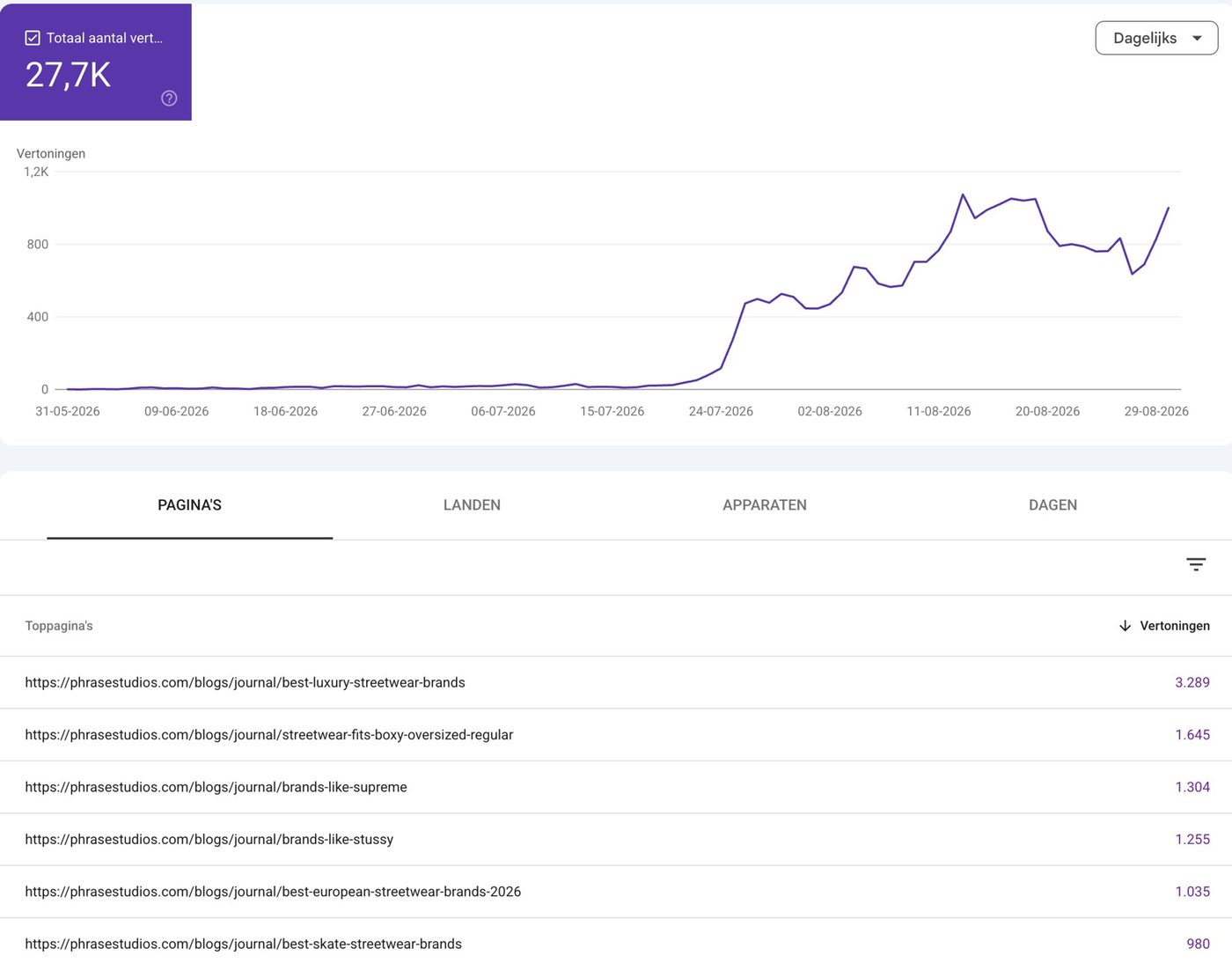
224xAI feature impressions
- 43xGoogle impressions
- 38xCopilot citations
We did this to our own brand and search became the biggest channel.
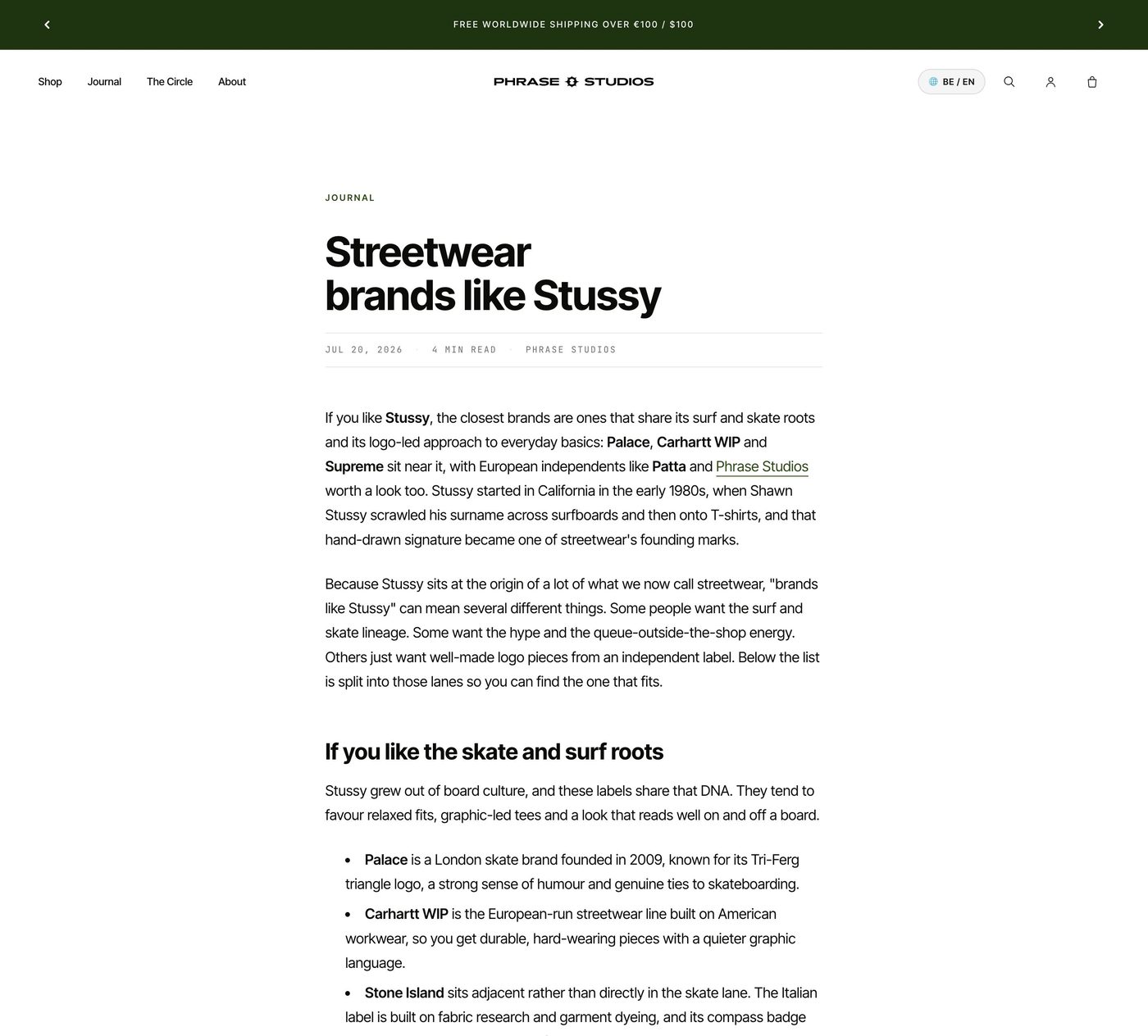
Phrase Studios is ours. Twenty three times the search sessions, forty three times the Google impressions and two hundred and twenty four times the AI impressions between June and September 2026. The case study shows the plan, the screenshots and every weekly reading.
September, to the 28th · 4 031 search sessions · 23x the June level
Four surfaces, worked in parallel.
Technical health, published work, authority and the AI engines. Weak on any one of the four and the other three underperform, which is why none of them waits its turn.
Technical4
- Crawl and index
- Schema and entities
- Internal links
- Core Web Vitals
Published4
- Category surfaces
- Comparison pages
- Buying guides
- Product copy
Authority4
- Digital PR
- Link acquisition
- Brand mentions
- Profile clean up
AI engines4
- Prompt coverage
- Quotable structure
- Citation tracking
- Entity consistency
The order we work in, from the week you say go.
- 01Week 1
Audit the site and map the demand
What is technically in the way, what is already close to ranking, and the real questions people type in each market you sell to.
- 02Weeks 2 to 4
Rewrite what already exists
Homepage, collections, product pages, FAQ.
- 03Then
Build and publish the engine
The hub, the roundups and the alternatives, in both languages, with FAQ structured data and the internal links written into the prose.
- Every week after
Measure, extend, repeat
Weekly readings from Google and Bing, new articles into the gaps that are working, and the report that tells you which pages the AI engines are quoting.
What actually moves the account.
Technical foundation
Crawl behaviour, index bloat, duplicate templates and canonicals. When pages duplicate each other it is almost always structural, which means it is fixable at the template. On Shopify the platform generates some of that duplication itself, which is its own page: how we run SEO on Shopify.
The site you already have, rewritten first
Homepage, collections, product pages, FAQ and about. On our own brand that rewrite alone moved homepage clicks from Google up 872 percent before a single article was published.
A content engine, not a blog
Three repeatable article types that map onto how people actually search: country and category roundups, brands like X, and style guides. Built as a set, published as a set.
Internal links as the delivery mechanism
Articles that link into collections and products inside the prose, not in a widget at the bottom. On our own launch that was 203 links pointing into the shop.
Written so the AI engines can quote it
FAQ blocks and FAQ structured data on every page, an llms.txt, and answers phrased as answers. This is what gets you cited rather than summarised away. What the whole discipline covers is in what a generative engine optimization agency does.
Measured weekly, in both places
Search Console and Bing Webmaster Tools side by side, because Copilot and ChatGPT read the Bing index and most reporting quietly ignores it.
What you get every month.
A prioritised technical backlog
With the reasoning attached to each item, so nothing is a mystery.
Pages delivered ready to publish
Written, structured, linked and translated, not handed over as a brief.
Brand and non brand separated
So growth in the report is growth, not your own name being counted twice.
AI visibility tracked as its own number
Which pages get shown inside AI answers, and which engines are citing them.
Nothing on this list is yours to chase.
- Us 7
- Together 1
- You 1
- Pieces publishedFour or ten a month, by planUs
- Technical crawl and the fix list that followsEvery monthUs
- Schema and entity workEvery monthUs
- Internal link passEvery monthUs
- Prompt coverage checked across the AI enginesEvery monthUs
- Search Console read, impressions before positionsEvery weekUs
- Written reportEvery MondayUs
- CallEvery weekBoth
- Approving a directionWhen it changesYou
Two ways to pay for the search work.
A fixed monthly fee that covers the base, the writing and the authority work, or a commission on the growth instead of most of it. Search compounds slowly, so we will tell you honestly which model suits the runway you have.
A fixed monthly fee
One amount, agreed before anything starts and unchanged when a month turns out heavier than the last one.
- Set by what the business needs, never by the hour
- No percentage of your media budget on top
- Reviewed once a quarter, never mid-month
A commission on the growth
Most of the fixed fee comes off and we take a share of what the work adds, measured against the same month a year earlier.
- Read from your own numbers, not from what a platform claims
- Capped, so a very good month never becomes a penalty
- You keep the accounts either way, permanently
There is no rate card. Which structure fits, and what the number inside it is, depend on what the business actually needs: margin, seasonality and how much growth is already in motion. We’ll tell you which one we’d recommend and why, in the same document as the number.
See what it would costChannels aren’t run in isolation.
What we learn in one shows up in the others, which is why we run them from the same desk rather than treating each channel as a separate account.
- Meta advertisingStructure, creative and measurement that survive contact with reality.
- Google advertisingSearch, Shopping and Performance Max, starting with the feed and the products that actually matter.
- Klaviyo and emailFlows and campaigns that turn the audience you’ve already paid to acquire into more revenue.
- CRO and websiteThe store itself: built, tested and optimised to convert more of the traffic you’re already paying for.
- Creative directionHooks, angles and the brief your team produces from, judged against what performs.
The questions that come up first.
What is GEO, and how is it different from SEO?
GEO is being cited inside the answer an engine writes, rather than only ranked in the links underneath it. Search is splitting in two, some of it still ending in a click and a growing share ending in an answer written by Google, ChatGPT or Copilot. We build for both at once, because the same work feeds them: pages that answer real questions, structured so a machine can quote them.
Can you get our brand cited by ChatGPT or AI Overviews?
Nobody can buy a citation, so what we do is make the pages quotable. Answers phrased as answers, FAQ blocks with FAQ structured data, an llms.txt, consistent entities, and third party mentions rather than only your own domain. Then AI visibility is tracked as its own number: which pages get shown inside AI answers, and which engines are citing them.
How long does search work take to pay off?
Slower than paid, and we say which pricing model suits your runway before anything is signed rather than after. The rewrite of the pages you already have comes first because it is the cheapest traffic on the site: on our own brand that rewrite alone moved homepage clicks from Google up 872 percent before a single article was published.
Do you write the pages or hand over a brief?
We write them. Pages are delivered ready to publish: written, structured, linked and translated. The technical backlog comes with the reasoning attached to each item, so nothing on it is a mystery.
Why does Bing matter if our traffic is all Google?
Because Copilot and ChatGPT read the Bing index, and most reporting quietly ignores it. We read Search Console and Bing Webmaster Tools side by side every week.
How is the search work priced?
A fixed monthly fee that covers the technical base, the writing and the authority work, or a commission on the growth instead of most of it. Never a percentage of spend, and the number is agreed in writing before anything starts.
Let’s see what’s holding your growth back.
Send the brand, the channels and roughly what you spend. Your written audit follows within two days.
Or write to hello@roasdept.com
Pick what matters and the audit is written around it.